Last updated November 17, 2026



Free written scope consultation - allowances, timeline, and change-order rules on paper before a single trade is scheduled
Driveway & Pavers Troubleshooting: Common Problems and How to Fix Them
If you’ve re-sanded the same sunken paver section twice and it keeps dropping, you haven’t fixed the problem – you’ve been filling a hole that’s still being dug from below. We see this constantly on driveways around Newport Beach: a homeowner spends a Saturday topping off joints, and six weeks later the same pavers are low again. The surface was never the issue. The base was. What most guides skip is how to tell the difference between base failure, bedding sand erosion, and plain paver damage, because each one has a completely different fix and a completely different price tag. This guide teaches you to read your driveway the way a contractor does, so you can stop chasing symptoms and treat the actual cause.
Quick Answer
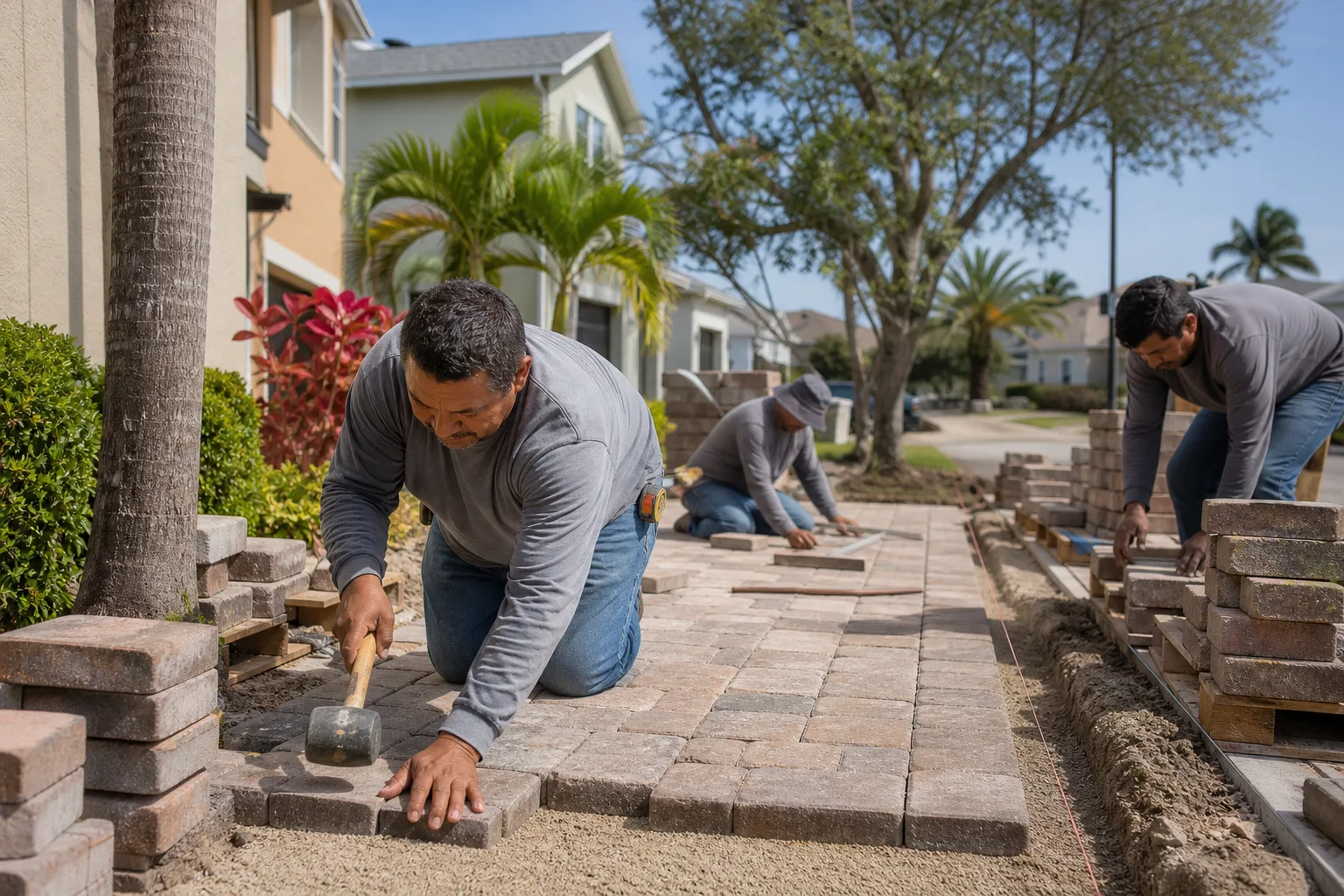
Most driveway paver problems – sinking, cracking, staining that won’t lift – come from below the surface, not from the pavers themselves, so the fix depends on diagnosing the base first. A driveway that keeps sinking in the same spot almost always has a water drainage or soil compaction failure underneath, and re-sanding over it just buys a few weeks. Surface-only issues like rust or oil staining are cosmetic and cheap to treat, while structural movement, spreading edges, and corner cracks mean the base or the restraint needs real repair.
Quick Answer: If pavers keep sinking in the same spot, the base is failing – not the sand. Re-sanding hides it for a few weeks; only base repair and drainage correction stop it. Cracked pavers that sit tight and level are usually a material or overload problem, while cracking with movement means the foundation has shifted.
Styles & brands we work with
- Kitchen remodeling
- Bathroom remodeling
- Home additions & ADU
- Roofing
- Windows & doors
- Driveway & pavers
- Fence
Table of Contents
- Base Failure vs. Bedding Sand Erosion vs. Paver Damage
- What Your Crack Patterns Are Telling You
- Efflorescence vs. Oil vs. Rust: Three Stains That Look Alike
- The 10-Minute Drainage Test
- What You Can Fix Yourself vs. What You Shouldn’t
- Why Newport Beach Driveways Fail the Way They Do
- What Repairs Actually Cost
- How to Keep It From Happening Again
Base Failure vs. Bedding Sand Erosion vs. Paver Damage
Three failures produce almost identical surface symptoms, and mixing them up is how a $400 repair becomes a $4,000 one. Here’s how to separate them.
Base failure is the big one. The compacted aggregate under your pavers has lost its density, shifted, or washed out – usually because water got into it or because it was never compacted properly in the first place. The tell is broad, repeated sinking. You’ll see a section that drops, you top it off, and the same section drops again within a season. Sometimes you’ll notice the pavers feel loose underfoot even when they look level. Base failure on a Newport Beach drive that sits near a slope or a downspout is especially common because our winter rain finds every weak spot in the subgrade.
Bedding sand erosion is the second. The inch or so of sand between the pavers and the base can wash out through the joints, especially after heavy rain or a hose running against the edge. The symptom is joint sand that vanishes quickly and pavers that rock slightly or develop small gaps. It’s cheaper to fix than base failure because the structural layer is intact – but if you ignore it long enough, the base underneath starts to erode too, and you slide into category one.
Paver-level damage is the third and simplest. A paver chips, cracks, or breaks because something heavy rolled over it or a corner was already weak. The pavers around it stay level and firm. This is a spot repair – pop out the damaged unit, reset it, done.
- Sinking in the same spot repeatedly = base failure, not sand
- Joint sand washing out fast, slight rocking = bedding sand erosion
- One or two broken pavers, rest solid and level = paver-level damage
- Edges spreading or pavers walking outward = restraint (edge) failure
What Your Crack Patterns Are Telling You
A crack is a symptom with an address. Where it runs tells you what’s happening underneath it, and this is one of the fastest reads in the field.
Linear cracks – long, straight, running across several pavers – usually point to a base issue running on a line, like a seam in the subgrade, a buried utility trench that was never re-compacted, or an expansion joint that wasn’t honored. If a straight crack runs parallel to your garage or a property line, look for a buried line or a hard edge the base was cut against.
Random, spiderweb cracks across a broad area point to overloading or a base that was too thin. Heavy vehicles, dumpsters, or a delivery truck parked on a driveway built for cars will do it. If your driveway is around 10 years old and the pavers are from a bargain batch, the material itself may be the weak link – which is why we push for suppliers like Belgard and Boral on any full replacement, because the pavers carry the same compressive strength guarantee as the base.
Corner-only cracks – the classic “dog ear” break at one corner of a paver – are almost always a bedding or leveling issue. The paver is bridging a small void and flexing until the corner snaps. That’s a local fix: lift, re-bed, reset. But if corner cracks are showing up in a dozen spots, the bedding layer has failed across the whole field.
Hairline cracks that follow the joint lines are usually nothing to worry about – thermal movement, not failure.
- Photograph the crack and note its length and direction.
- Press down on the pavers on both sides. Movement on one side means base or bedding failure, not just a cracked face.
- Check whether the crack runs toward a downspout, a slope, or a buried line – that’s most of your diagnosis.
Efflorescence vs. Oil vs. Rust: Three Stains That Look Alike
White, dark, and orange-brown marks on pavers look like the same class of problem. They’re not, and treating one like the other can make it permanent.
Efflorescence is the white, powdery, chalky haze that shows up on concrete pavers – especially in the first year and especially after a wet winter. It’s naturally occurring mineral salts migrating to the surface as moisture moves through the paver. It is harmless to the structure and it usually fades with weather exposure, though a paver cleaner formulated for efflorescence will speed it up. Don’t scrub it with acid unless the manufacturer’s instructions allow it – acid on fresh pavers can etch the surface and void the finish warranty.
Oil staining is dark, sometimes iridescent, and usually concentrated where a car parks. It’s hydrocarbon, and standard pressure washing doesn’t remove it. A poultice or a pH-appropriate degreaser is the right treatment. Timing matters – the longer oil sits, the more it penetrates. Newport Beach driveways that host the weekend boat trailer or a leaky older car see this constantly.
Rust staining is the orange-brown one, and it’s the one homeowners most often misdiagnose as dirt. It comes from three places: fertilizer with iron in it, metal furniture left out in the rain, or rebar in a concrete section that’s been exposed. If rust is near a lawn edge, the fertilizer is a good suspect. If it’s centered on a spot where the pavers gave way at a corner, buried steel is the likely source.
- White and chalky = efflorescence, generally cosmetic
- Dark and greasy = oil, needs a poultice or degreaser
- Orange-brown and localized = rust, trace the source first
The 10-Minute Drainage Test
Water is the culprit in the majority of driveways we’re asked to inspect in Newport Beach, and you can prove it in about the time it takes to make coffee.
Here’s the test. You need a hose, a couple of handfuls of sand or chalk, and a ruler.
- Pick the lowest-looking section of the driveway – usually where the sinking is worst.
- Set the hose on a moderate flow at the highest point of that section and let it run for 5 minutes.
- Watch where the water pools. If it puddles in a low spot and sits there after 5 minutes, you have a drainage or slope failure – not just a paver issue.
- Check the edges. Water running off the driveway edge instead of to a drain or landscape means the grade is wrong or the edge restraint has failed.
- Look at the downspouts. If a roof downspout discharges within 6 feet of the driveway, that’s a water source you can redirect – which is one of the cheapest fixes in the guide.
- Check joint sand after the test. If a section of joints is suddenly drained of sand, you’ve found the water path.
If water pools and sits, the repair is re-grading and correcting drainage – a base-level job. If water runs off correctly and the driveway is still sinking, you’re looking at compaction failure and the diagnosis goes deeper.
For local reference, Newport Beach’s rainy season runs late fall through early spring, and the standing water problems show up fast in older neighborhoods with flat grades. Our Driveway & Pavers in Newport Beach team runs this test on almost every repair estimate because it changes the recommendation.
What You Can Fix Yourself vs. What You Shouldn’t
A handy homeowner can save real money on some of these. Others quietly void your warranty or make the underlying failure worse, so knowing the line matters.
Homeowner-safe fixes:
- Replace a single cracked or broken paver – pop it out, clean the void, re-bed with proper sand, tap it in, re-sand the joints.
- Re-sand the joints once, correctly, after a clean and dry period. If the same section needs re-sanding twice in a season, that’s a base problem, not a maintenance problem.
- Clean efflorescence with a manufacturer-approved cleaner.
- Redirect downspouts away from the driveway.
- Remove oil stains early with a poultice.
Leave it to a contractor – and don’t attempt it yourself:
- Base repair or replacement. Lifting and resetting pavers over a rebuilt base requires excavation, compaction in lifts, and proper aggregate. Getting compaction wrong voids the guarantee and re-creates the exact problem.
- Edge restraint failure. The hidden edge that holds your whole driveway from spreading needs to be dug out, re-set in concrete, and re-specified. Getting this wrong is how a driveway starts walking apart at the border.
- Drainage re-grading across a slope or toward a storm drain – this touches grading you may not own.
- Root cause of repeated rust staining from beneath the surface, especially if a paver section is obviously moving.
One more DIY caution that gets overlooked: if you’re still inside a manufacturer’s material warranty or a contractor’s workmanship warranty, a DIY repair on a structural problem can void it. Before you dig, check what your paperwork covers. Any full-scope repair from our team is covered by the 730-Day Done Right Promise – if it’s not done right, we make it right – which is a coverage that a self-repaired driveway doesn’t have.
Why Newport Beach Driveways Fail the Way They Do
Our local failures aren’t generic – they follow the terrain. Newport Beach sits between ocean, bay, and hills, and each zone produces its own version of driveway trouble.
Coastal salt air and moisture. Driveways in areas like Balboa Peninsula and Corona del Mar see persistent moisture and salt exposure. That drives efflorescence and accelerates the freeze-thaw-like movement that opens joints. Pavers from suppliers like Belgard and Boral handle salt exposure well, but the edge restraint and joint sand are the weak points.
Hillside lots. Up in neighborhoods with slope-driven grading, water runs off the hill into the driveway edge during winter storms, and the surface gets a bath it wasn’t designed for. Base erosion on a hillside drive is fast – often in a single wet season. This is one of the reasons we build drainage corrections into most hillside driveway jobs.
Older inland flat grades. Flat, older driveways with shallow slope hold water. The 10-minute test will find these in seconds. The fix is usually re-grading, which means lifting the pavers – a base repair, not a surface one.
We’ve also seen enough Newport Beach driveways to know that the paver itself is rarely the failure. In nearly every case we’ve inspected where the same section sank twice, the pavers were fine – the base was not.
What Repairs Actually Cost
Repair pricing lands in very different places depending on which category you’re in. Here’s the real spread. These are ranges for a typical residential driveway in the area – the final number depends on access, square footage, and how deep the base repair goes.
- Single paver replacement / spot reset: $75 – $250 depending on count and access
- Re-sanding joints, single clean: $150 – $400 for a standard driveway
- Efflorescence or oil stain treatment: $150 – $350, mostly labor and cleaner
- Edge restraint repair (linear feet): $25 – $60 per linear foot, more where concrete has to be removed
- Section base repair (lift, rebuild, reset): $10 – $22 per square foot
- Full base replacement with new base and re-lay: $18 – $32 per square foot if pavers are reusable, more if new pavers are added
- Drainage correction (redirected downspout, re-grade, drainage channel): $500 – $2,500 depending on scope
The gap between the cheap fix and the real fix is usually the diagnosis. A homeowner who replaces one paver at the wrong failing spot is out a few hundred dollars and still has the problem. A homeowner who lifts a section without rebuilding the base is out a few thousand. The right move is to diagnose first, then price. We do free estimates with upfront pricing and a written quote that doesn’t change once we start – the number you see is the number you pay.
How to Keep It From Happening Again
A repaired driveway can stay solid for a long time if the water and the base are handled correctly. Here’s what actually works.
- Redirect every downspout at least 6 feet from the driveway edge. This is the single highest-leverage fix and usually costs almost nothing.
- Keep joints full and compacted. Joint sand is part of the structure, not decoration. Re-sand once a year after the wet season, with the correct polymeric or stabilized sand for your paver type.
- Clean without over-washing. Low pressure is enough for routine cleaning. Blasting joints out with a high-pressure nozzle is how driveways erode their own sand.
- Keep heavy loads off the driveway. Delivery trucks, dumpsters, and loaded trailers crack pavers and thin bases. Ask for delivery in the street.
- Fix the first corner crack, not the tenth. A single failed paver usually means water found a path. Repair early.
- Have any new base work specified in writing before signing. A driveway is only as strong as its base, and the specification is the only proof you’ll ever have that the base was built right.
If you’re going to build or replace, the same logic applies – a well-specified base and drainage design makes a driveway outlast a cosmetic build every time. Our Groundwork Construction Co. of Newport Beach home page outlines the full-scope approach we bring to any drive project, from base design to finish materials.
Common Mistakes to Avoid
- Re-sanding over a sinking spot and calling it fixed. If the same section needs re-sanding twice in a season, you’re covering a base failure, not repairing it.
- Assuming white stains are dirt. Efflorescence treated with the wrong cleaner can etch the paver surface and void the material warranty.
- Pressure washing the joints to clean the surface. High pressure blows out the joint sand, opens paths for water, and accelerates base erosion.
- Ignoring edge restraint. The border looks fine while the whole field is walking outward. By the time it’s visible, the repair is 10x bigger.
- Skipping the drainage test on a slope. Newport Beach hillside driveways fail because of where the stormwater goes, and a cosmetic repair doesn’t redirect water.
- Doing structural repair yourself inside a warranty window. A DIY base repair is a warranty void, and it’s usually done without compaction equipment.
- Bargain shopping a full replacement on material alone. The expensive part of a driveway is the base; saving on the pavers and skimping on the base is how a 20-year driveway becomes a 5-year one.
See the difference
 Before
 After
 Before
 After
 Before
 After
When to Call a Professional
Some driveway paver problems genuinely need a contractor. If the same section has sunk twice, if you see the field spreading or walking outward, if cracks appear alongside noticeable movement, or if the drainage test showed standing water you can’t redirect – those are base and drainage failures that surface fixes can’t touch. Bring in a professional when the repair involves excavation, compaction, edge restraint, or re-grading. Cosmetics, a single paver, and one re-sanding you can handle. Beyond that, you’re paying twice if you guess wrong.
Groundwork Construction Co. of Newport Beach offers free estimates in Newport Beach – call (833) 749-3967. Our technicians have up to 12 years of experience, and every project is backed by the 730-Day Done Right Promise. Calls are answered by a live person, 24/7 – no voicemail black holes.
Frequently Asked Questions

It depends on the category. Spot paver replacement runs about $75 – $250, section base repair runs $10 – $22 per square foot, and full base replacement with re-laying runs $18 – $32 per square foot if pavers are reusable. Drainage corrections add $500 – $2,500. Call (833) 749-3967 for an exact quote – estimates are free.
Not from us. We quote from the diagnosis, put it in writing, and the number you see is the number you pay – upfront pricing with no change orders once the repair begins. If we find something unexpected during excavation, we stop and show you before doing anything else.
The base under that section has failed or is eroding, and re-sanding the joints over it just buys a few weeks. Water finds the weak spot and keeps washing it out until the base is rebuilt and the drainage source is corrected. A 10-minute drainage test will usually find the water source.
You can safely replace a single cracked paver, re-sand joints once, treat efflorescence or oil stains, and redirect a downspout. Base repair, edge restraint failure, and drainage re-grading should go to a contractor because they need excavation and compaction equipment, and doing them yourself can void your warranty coverage.
White, chalky marks are almost always efflorescence – mineral salts migrating to the surface as moisture moves through the paver. It’s cosmetic and typically fades with weather. Clean with a manufacturer-approved efflorescence cleaner and never acid-wash unless the manufacturer’s instructions specifically allow it.
Structural base replacement and drainage re-grading often require a permit depending on the scope and the site. We handle permitting as part of the job and pass inspection before we’re done – that’s part of the 730-Day Done Right Promise and part of how we keep the work defensible on a resale inspection.
The Bottom Line
Read the driveway like a contractor. Same spot sinking twice means the base failed, not the sand. Cracks tell you where the failure lives – linear for base seams, random for overload, corner-only for bedding. Stains need to be sorted before treatment: efflorescence is cosmetic, oil needs a poultice, rust means find the source. The 10-minute drainage test is the cheapest diagnostic you’ll ever run. Handle the cosmetic and single-paver fixes yourself; leave excavation, edge restraint, drainage, and base rebuilds to a pro. And build the next one on a properly specified base – that’s the whole difference between a driveway that lasts 5 years and one that starts failing at 15.
Wherever you’re planning a driveway project or a full exterior footprint, our related work across Fence Installation in Newport Beach and Home Additions & ADU in Newport Beach is handled by the same team and covered by the same 730-Day Done Right Promise. Every project starts with a free design consult and a written line-item quote, and 0% financing for 18 months plus $1,000 off projects over $10,000 is available on qualifying work.
If your driveway is sinking in the same spot, spreading at the edges, or can’t pass the drainage test, call Groundwork Construction Co. of Newport Beach at (833) 749-3967 for a free estimate. A live person answers, 24/7, and our background-checked, uniformed technicians arrive with an upfront price before a single paver is lifted. Call (833) 749-3967 to schedule your free estimate.
Written by the team at Groundwork Construction Co. of Newport Beach.